Produce Prescriptions w/Caleb Thomason (Appalachian Sustainable Agriculture Project) - WNC Health Policy Podcast Ep. 26
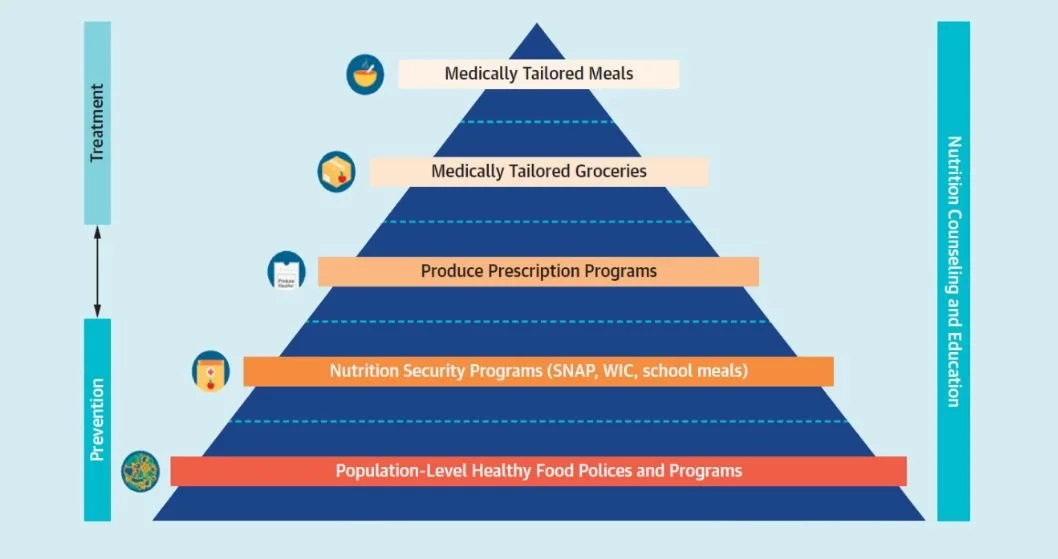
Image Credit: Mozaffarian et al., Nature Medicine 2022, via Tuft’s - About Food Is Medicine
In the latest episode of the WNC Health Policy Initiative Podcast, we learn from Caleb Thomason about ASAP (Appalachian Sustainable Agriculture Project)'s Produce Prescription Program and how it overlaps as a public health strategy to improve nutrition, increase access to healthy food, and support long-term health outcomes.
By connecting healthcare providers with local farmers and markets, the program helps participants access fresh fruits and vegetables while strengthening Western North Carolina's agricultural economy.
The conversation also places Produce Prescription programs within the broader "Food Is Medicine" movement, which a growing set of interventions that includes medically tailored meals and nutrition incentives like Double SNAP at Farmers' Markets, each designed to address chronic disease through food.
The Produce Prescription Program recently received $400,000 in renewed funding from Blue Cross NC to continue and expand programming into the next year, pointing also to evidence of healthy food access as a long term cost-savings strategy for health insurance providers.
Regarding state policy, the Healthy Opportunities Pilot was a recent success story in addressing upstream determinants of health, like food access. While the state still has no budget and the future of HOP is unclear, other policies that engage both rural farm economies and food access include the proposed House Bill 1154, 'Expand the FarmSHARE Food Hub Program' which seeks to allocate some funding to Double EBT at farmers markers.
Learn more about this program in WNC
Transcript
AR: Andrew Rainey
CT: Caleb Thomason
Resources:
INTRO
[sounds of water flowing]
Caleb Thomason: One of the staggering things that we see is a 10% reduction in food insecurity, and then we've seen about 12% reduction in fair or poor health as well. So not just that farmer support piece, but also support to get them closer towards their desired health outcomes.
[banjo music]
Andrew Rainey: You're listening to the Western North Carolina Health Policy Initiative podcast. A collaboration between the North Carolina Center for Health and Wellness at UNC Asheville and MAHEC, with generous support from the Dogwood Health Trust. I'm Andrew Raney. In each installment, we speak about different public health strategies for improving health and well-being in western North Carolina. Individual opinions, findings, conclusions, or recommendations expressed in this podcast are those of the participants and do not necessarily reflect the views of the Western North Carolina Health Policy Initiative or its host institutions of UNC Asheville, the Mountain Area Health Education Center, or our funders.
Recorded on the flickering internet waves of mountainous Appalachia, today we're talking about food as health care, and about a strategy that links public health, chronic disease, and local agriculture directly together.
Interview with Caleb Thomason
[soft strummed music]
AR: Today, our guest is Caleb Thomason from ASAP, the Appalachian Sustainable Agriculture Project, an organization that has spent years looking at how to strengthen local food systems across Western North Carolina.
One of the explicitly health-related programs that they use is something called a produce prescription, where healthcare providers connect patients directly with fresh fruits and vegetables as part of a treatment and prevention effort. As policymakers and healthcare systems are searching for ways to improve health outcomes while lowering costs, produce prescription programs could be a practical community-based intervention that seems to address nutrition, food access, chronic illness, and the ability to farm in rural areas all at once. We'll talk about how these programs work, what impact they're having in Western North Carolina, and what that could mean for healthcare policy. Especially after the Healthy Opportunities Pilot ended, Medicaid and FDA cuts are being felt, and some rural health transformation money rolls in.
AR: Thanks for being here, Caleb.
CT: Yeah, I appreciate you having us. And yeah, it's a pleasure.
AR: Could you start by telling us what ASAP is?
CT: So Appalachian Sustainable Agriculture Project, or ASAP for short, we're a nonprofit based in Asheville, but we serve the southern Appalachian region, which is roughly 100-mile radius around Asheville, so we stretch into other states as well. And then we serve the 23 westernmost counties in North Carolina. Our mission is to help local farms thrive, link farmers to markets and supporters, and build healthy communities through connections to local food. So we do a lot of direct work with our local farmers, and some of the indirect work we do is in our incentives programs at farmers markets in the region.
AR: So y'all are firmly rooted in Western North Carolina and have a focus on supporting farmers. But thinking health action more specifically, that's where we start to see a couple programs come in. Can you tell us about those?
CT: So we have two programs that we run. One is the Double SNAP, where SNAP customers can swipe their EBT card for any amount and will receive that amount in SNAP tokens as well as $20 in additional Farm Fresh Bucks, which are another different kind of token that are good for fresh fruits and vegetables at the market. And then the second program is our Farm Fresh Produce Prescription program, and for that program, participating healthcare providers can prescribe their patients and clients fresh fruits and vegetables to help treat and or prevent diet related illness.
Our prescriptions are six months, and basically how it works is folks, once they're enrolled in the program, we send monthly—they're kind of like business card size, we call them voucher cards—that are good for four redemptions for their prescription amount a month. The prescription amount varies by household size. And so households are eligible for up to $60 a week or a market visit. And basically how it works is they take that card to a participating farmers market and show it to the market staff at the information table. They receive up to that 60 bucks redemption for the week. And it's those same tokens that we use for the Double SNAPs. So they're Farm Fresh Bucks, and they can be used to purchase fresh fruits and vegetables at the market.
AR: You mentioned two programs, SNAP and then produce prescriptions. SNAP, of course, being the result of federal health policy, and then the produce prescription, which is something we want to especially highlight in this conversation. Before we get into the details of produce prescriptions, can you tell us about the problem these programs are trying to address in Western North Carolina?
CT: Yeah. For our program, we want people to spend their dollars on local food, right? So we are trying to do everything we can to support farmers. So for us, it was born as both an opportunity to bring dollars to markets and put dollars in farmers' pockets that may not have been there, while also looking at it from a lens of how do we support our community? How do we get people not just to farmers markets, but also support them in that experience.
Especially anecdotally, there is a perception that farmers markets are more expensive, and sometimes that is the case, and sometimes for very good reason. Your potato at a farmers market is more than likely gonna be more expensive than the russet potato you get at the grocery store, right? And that's for good reason. And that's also not always the case. Sometimes you can find a local product cheaper.
But to answer your question more directly, we wanted to explore opportunities to bring more people to the farmers markets that traditionally either felt that the space wasn't for them or felt that maybe it was too expensive. We wanted to provide an opportunity to get more people to the market. And we wanted to lean into that healthy eating practice side of how, not only do we get people to the market, but make it a dual benefit. How do we look at it from that kind of public health lens of, we want people to eat fresh local food but we also want to talk about and educate about the benefits of eating that healthy, local, fresh food, and not just from the physical health side, but also the social health side.
So we know that social environments significantly impact food choices, right? So one of the big benefits of a farmers market is that it does offer that environment that encourages eating fresh and seasonal fruit and vegetables, cooking at home, and eating with that broader community. And so in addition to bringing people to the farmers markets to put more dollars in farmer's pockets, we wanted to really drive home the benefit to our local community. We wanted to address some of the issues that we know exist in our community with a lot of people in our program.
So when we enroll folks in our survey, we send out a baseline survey, and then after the six months, we send out a post-survey. One of the staggering things that we see is that I believe it's 53% of folks at the baseline report food insecurity than in the post, we've seen 43%. So we've seen a 10% reduction, and that's big. And then we've seen about 38% report fair or poor health, and we've seen a 12% reduction in that as well.
So addressing not just that farmer support piece, but also food insecurity and then that fair or poor health, that kind of high percentage of folks who feel like they are not where they want to be with their health, we want to provide an opportunity to introduce them to fresh fruits and vegetables and help support them in how to use that to benefit them and get them closer towards their desired health outcomes.
AR: So for y'all, this is first an economic question in how to support local farmers in Western North Carolina. And then on top of that, impact health outcomes by increasing connections between folks out here and those farmers so that people are getting healthier food.
What is a produce prescription and how does that work for patients?
CT: Yeah, yeah, so a food prescription is exactly what it sounds like. Ours is specifically a produce prescription. So healthcare providers...we partner with five currently in the region, MAHEC, Buncombe County, DHHS, both the WIC and Nurse Family Partnership, Appalachian Mountain Health, and Hot Springs Health Program over in Madison County. And how it works is providers that we partner with and do an onboarding with providers who are going to be writing prescriptions. They visit with their patients' clients and then determine if they meet the eligibility requirements.
For our program, the eligibility requirements are folks who are suffering from or at risk for developing a diet-related condition, and they have to meet one of two criteria: They need to be eligible for a federal supplemental nutrition program, such as SNAP or WIC, or they need to have somebody in the household that is enrolled in Medicaid or CHEP.
If they meet those requirements, the provider will talk a little bit to them about our program. If it feels like a good fit, the patient or client will say, “Yeah, that sounds good. Tell me more.“ And they'll send a referral to us. One of our staff will give that person a call and chat a little bit more about the program, tell them what to expect, tell them where they can go. We have a whole list of onboarding materials that are meant to be helpful when we first send that digital and physical mailer...letting them know how the program works, where they can go to redeem their prescription, and how they redeem their prescription. And then we mail them those prescription ID cards. They take those cards to a participating farmers market. We currently have 13 in a four-county region. They get their tokens and they shop.
One of the reasons we do the market model is for consumer choice. We want folks to have options. We want folks to purchase what they're going to eat. And we have done food box models, and there's really value in both. One of the barriers to our model is you do have to go to a farmers market, for example. So transportation, mobility, schedule...people have busy schedules, and farmers markets can be a wonky time, so there are certainly barriers to our model. and benefits to other models. But we want folks to have that choice. We want them to be able to go to a farmers market, pick out whatever they want for themselves and or their households, and we go from there.
AR: Okay, so folks with eligibility, financial and health condition, determined by a participating healthcare provider, receive tokens that work just like money to get fresh fruits and vegetables at local farmers markets, where they can choose what works for them within that healthy food selection.
Thinking tokens and farmers markets, that sounds similar to EBT tokens. And y'all do that too, right? Can you break down what that is? Then we can look at how they're different.
CT: Yeah, yeah. So SNAP is a federal program. It's designed to support families and households who could just benefit from having extra dollars, usually targeting lower income populations. and providing benefits for their grocery store visits, for farmers market visits, wherever they shop. And in terms of our Double SNAP program, we started this program as a way to just both address the parts of our communities that we were missing in farmers markets.
So we have a local food research center at ASAP, and we like to keep up with who's shopping at our farmers markets in the region, right? And it may or may not come as a surprise to know that at a lot of farmers markets, typically is representative of a higher income bracket, usually predominantly white, predominantly middle-aged, and predominantly higher educated in terms of looking at the region as a whole, who's shopping at farmers' markets is not fully representative of our whole community. And so one of the ways that we wanted to address that was by creating Double SNAP and pushing to get SNAP acceptance at farmers markets in the region and trying to support markets in achieving that.
The Double SNAP program is exactly what it sounds like. If you take your SNAP EBT card to a farmers market, you can go to the information table at that farmers market, scan your SNAP or EBT card there, and you will receive that amount in SNAP tokens, and then those $20 in Farm Fresh Bucks. So the SNAP tokens can be spent on any SNAP-eligible items, and those Farm Fresh Bucks can be spent on fresh fruits and vegetables.
AR: Gotcha. So EBT can be used outside of the local food system, but the Double SNAP incentivizes supporting local farmers, albeit with a wider choice of foods than the produce prescription. And then the produce prescriptions are really emphasizing foods to support folks navigating a variety of health conditions and through a healthcare provider directly.
This is making me realize that there's really a wide variety of strategies being explored to connect healthy foods to folks who otherwise may not have access. Although the entry point being a healthcare provider is maybe what's most novel here.
CT: Yeah, big time. So there's different implementation methods, and a lot of it comes down to the actual model that the program's implementing. So when I talk about market model, that's our primary model for implementing a food prescription. Typically, you're going to have some similarities in implementation. So you're typically going to have multiple healthcare providers actually writing those prescriptions.
In terms of what they contain, produce prescription is its own thing. There are other models. For example, there's also this model of medically-tailored groceries, medically-tailored meals, where folks are actually given either like a meal kit—think of like a blue apron or whatever, something like that—that is specifically they are prescribed that medically tailored meal. And those are usually going to be a lot shorter in terms of length. You're looking at probably weeks versus months of receiving those. And then kind of a step down from that are like medically-tailored groceries, which are more all-encompassing than produce prescriptions typically, like they may have eggs, they might have meat, dairy, that sort of thing.
And then produce prescription is kind of its own thing where it is produce specific. There isn't meat, dairy, eggs, that sort of thing involved. And then yeah, in terms of implementation in the region, we are definitely not the only people doing it.
AR: Cool, so there's a very controlled version, meal by meal, ingredient by ingredient sort of thing, which sounds more expensive to keep up and requires a lot of management. And then there's the more EBT style way where you have a larger choice-based access to farm-fresh foods. fruit, produce, meat, cheeses, and eggs, which doesn't take a whole lot of clinical or dietary know-how, but plugs people into high-quality food. And of course, there's choice. And then there's y’all's version, which kind of sits between them. It's only fruits and vegetables, which is more targeted in that it directs it a little bit more to the fruits and vegetables that could have a really positive impact on the diet, but might be less known to folks generally.
CT: There's a great pyramid as well that just serves as a great visual that just shows like, at a foundational level, when you talk about these different, like, styles of programming, you're talking about Food is Medicine. And then there's like this Food is Medicine pyramid...it doesn't capture everything being done, but it kind of shows like Double SNAP is that foundation all the way up to that medically-tailored meals piece being like the pinnacle, where this is the ideal, but also, like you said, it's very expensive and it's going to reach fewer people. And then right there in the middle is produce prescription, where it's kind of combining those efforts of like accessibility, typically there's going to be choice involved, and it is a little bit more tailored specifically to the needs of an individual.
So there's a lot of different types of programming and models in the world of Food as Medicine. In terms of this type of program, we're the only one we know of in the region doing this kind of market model style programming. And honestly, one of the only programs like this nationally. They're similar but different programs going on. Often at the market level, you see Double SNAP. That's the main model.
But anyway, yeah, it's an interesting conversation where you differentiate from like Food is Medicine from prescription, where prescription is a model within Food is Medicine.
AR: Awesome. So we'll link that in the show notes.
So you mentioned how folks can access foods and, importantly, choose which ones they want to eat by attending farmers markets. Of course, farmers markets, like you mentioned, are not necessarily the most accessible spaces, whether through a sense of belonging and who it's for, or even just thinking across Western North Carolina, issues like transportation and getting to one.
Can you talk about how this looks in very different parts of our region and how you navigate that challenge of a program across different communities?
CT: Yeah, you're totally right. That community adaptive piece is so crucial. What works in Buncombe County, where we have so many farmers markets and the farmers markets are pretty robust. We have people traveling from all over to be vendors at some of these farmers' markets. Versus, you know, if you go a few counties over, if you go to Swaine County, for example, the farmers' markets are there for sure, but the choice is limited in terms of both number and folks who are vending there. And so getting creative and trying to understand the community before implementing one of these models is so, so important.
Yeah, it's something that we partnered with and have looked to really address in some of our other rural communities in partnership with organizations that are based in those communities to try and streamline and create a program that is beneficial for that community, versus exactly what you said, the market model just isn't feasible for everyone.
AR: You mentioned the program was across 4 counties. Which 4 in Western North Carolina are participating?
CT: Yeah, good question. Buncombe County, Henderson County, Haywood County, and Madison County are the four counties. And even in implementing the market model in three of those counties outside of Buncombe, we have two markets in Henderson County, we have one in Haywood, and one in Madison County. And Madison County, for example, it's a great market. It's Mars Hill's farmers market. But Mars Hill is pretty far away from Hot Springs, for example, in the same county.
And so, thinking about things not just from like, yeah, there's a market there that's perfect. Thinking about it from like, this is a huge county. So we advertise that we're serving Madison County, but maybe not all Madison County residents feel like it's a good fit. So still thinking about even in our current implementation, there are barriers for the residents that we're trying to serve. And trying to get creative about how to address and support the folks that we may be missing with our current implementation is important.
AR: That's right, and part of why we think of ourselves as Western North Carolina, as there's a lot of shared experiences across the mountains, but also the variety of communities can be big and always not county-specific in identity. You know, folks might go to a neighboring county for friends, family, work, or services.
Well, for something that connects agriculture, economics, and health across 4 counties, how would you describe the partnerships that are born out of this project and are needed to sustain it?
CT: Yeah, there's so many—there's almost too many to name, so forgive me for doing some bucketing. But first and foremost, we have several funders. We have grantors and donor support that really make this happen from federal to state to more local level of support that allows us to continue this program and keep it going.
Also, our health care providers, again, MAHEC, Buncombe WIC, Buncombe Nurse Family Partnership, Appalachian Mountain Health, and Hot Springs Health Program have all been great. We've had several other healthcare medical providers in the past that we've had great partnership with as well.
We have 13 farmers markets that are so important to implementation. And we have around 90 farmers a year that are selling fresh fruits and vegetables with this program. Couldn't do it without them. And in addition to farmers selling produce, they also participate....we try and do collaborations like U-Pick, farm tours, cooking demos, plant starts. We recently had a mushroom start and a plant start class. Both of those were led by two of our regional farmers supporting the community and going above and beyond, it really is a dual benefit.
And of course, our participants. Going back to that conversation about just addressing stigma in the region around these types of programs, it's not a handout at all. It is genuinely a dual benefit where we're talking about hundreds of thousands of dollars over the course of just a few years going into the pockets of farmers because our participants are using this program.
So we try and look at it holistically, that our participants aren't just recipients. They genuinely are partners and a key component of making this happen.
AR: Yeah, it takes all the folks to make the community well. I appreciate that framing. And also how it's not a handout situation, but an investment that has positive impacts across multiple sectors. We've heard that with folks at the Food Hubs and Healthy Opportunities Pilot, as well.
You had mentioned some of the general regional challenges you all have aimed at addressing, namely how rural farmers struggle to stay afloat and reach a broad market amidst everything else, as well as the level of food insecurity and barriers for folks in Western North Carolina to access fresh food. What have been some of the challenges in implementing the program?
CT: Great question, and those challenges have kind of evolved with the program. So one of those things for our market model specifically is managing those barriers to just getting to a market, whether it be schedule, transportation, mobility issues. There are a lot of reasons, and good reasons, why individuals and households who have been enrolled in the program don't use the prescription. It sounds good on paper, but then the reality of managing all those moving parts of a lot of these weekday markets might take place while I'm at work, or I have to pick up kids, or whatever the case is. It can be a number of reasons, when you have a three-hour market that's one day a week, that folks are struggling to get there. It could also be transportation. It could also be...I have difficulty leaving the house and maybe I don't have somebody who can do that shopping for me consistently. So just acknowledging that our market model in that way has barriers.
Another piece of that is right-sizing the program. You get caught in this space and it's easy to get sucked in of like, we want to do everything. We want to make this viable for everybody. And that's just not feasible...so figuring out that balance of addressing these barriers within our means, as well as staying focused on what our intentions are, showing the value of our particular model. It's kind of delicate. And so that is always a barrier.
And again, going to your question about partnership barriers. When we first started up, we started our program right before the peak of the pandemic is when funding came rolling in. And so we received funding, and then we had this shutdown in effect. And then we received additional funding to support people post-COVID as folks are starting to return to something resembling normalcy. We had to figure out how to spend that money. And so we did go with that kind of breadth approach of like, we have to generate interest, we have to generate demand for this program before we can ever show the value of it. There was just a lot of moving parts in terms of how we were implementing, and we did open the door to basically healthcare providers that were interested. The folks at the time—this was before I was on board—but were out there hustling, trying to generate that interest and telling people that this is a resource that exists for our community. And they did an amazing job of generating that interest.
Then the problem becomes, there's too much interest, the demand is so high, and we are working with grant funds and some donor support as well. The farmers market model, we had a delivery model, we were doing a pilot rural community model, and they were all great and well received. The issue then becomes we're spending beyond our means, and so we want to create a sustainable program. What are the pieces that we want to highlight and really focus our resources to slow down the spend to continue this program long term. And then you've got to make difficult decisions.
So we had to pause delivery. We continued with the rural box model that we were doing in partnership out west in Swain and Macon County with the health departments there, as well as a farm aggregator there who was providing the food boxes, and several community-based organizations that were doing all sorts of stuff from cooking demos to organizing events, really doing the logistical side of things while we were just putting up money for funding.
So all that to say, one of those challenges is when you have one of these programs is sometimes you just have to shift with the funding and what you have to make it valuable and to make it sustainable. And with that, consistency with funding is probably the biggest challenge.
You know, we were part of the Healthy Opportunities pilots, and that was not the biggest in terms of numbers of participants that we were bringing in with that, but it was still a pretty significant amount of folks, it was a significant amount of money that was going back into our community that was supporting those individuals with Medicaid that could benefit from services like ours. And so when Healthy Opportunities was paused, that's a big loss to our community. That's a big loss to a lot of folks who were benefiting from programs that they traditionally could not receive through their Medicaid providers.
So yeah, the biggest challenge is just that kind of adaptation piece and being flexible while also trying to remain consistent. But we've been very fortunate to have that fairly consistent funding and be able to continue some iterations of our programming.
AR: Well, having continued on and adapted, now operating a series of farmers markets in four counties in Western North Carolina, I wonder if you could talk about some of the data y'all collect to track things like impact and how it's working?
CT: Programming—internally, we kind of view it in years of like 2022 to 2024—was really robust for us in terms of the number, the sheer number of households we were enrolling in our produce prescription program and the breadth of different types of programming we were offering at that time. So we actually have recently released a impact report for the program during that period—be on the lookout for that.
But yeah, some of the things that we have looked at is, one, we want to know some pretty basic things. Like we want to know average household size, average amount redeemed per market visit across all of our participants. We want to know...some of that demographic data is a little bit trickier to get because we don't want to make this program very invasive. We want to make it as simple and comfortable access as possible from the participant side, and balancing that out with also gathering data can be tricky. But we send out these baseline surveys and these post surveys to all our participants at the beginning and end of their prescription.
And to get back to your point about some of the impacts that we've seen. That food insecurity piece: At the baseline survey, around 53% of folks self-report that they feel food insecure. On the post, around 43% say that they're still feeling food insecure. 43% is still a big number, but 10%. drop in a six-month prescription we feel is pretty significant.
We've seen around a 12% reduction in folks self-reporting fair or poor health, from 38% saying that they felt their health was fair or poor at the beginning of the program to around 26% towards the end of the program.
And then on the learning side, the educational component, we do monthly events that we encourage participants to attend if they're able and interested. We put out a lot of materials into the world from simple things like recipe cards—how do you use this produce that you're buying? Here's some ideas. We put out newsletters monthly with different resources and different tips for shopping, again, more recipes, trying to highlight different fruits and vegetables, different seasonal produce that folks can purchase and the benefits of that particular item.
That simple but pretty effective stuff has given us a pretty big return. Around 50% of our participants have reported learning something new about local food and how to use it, and 75% report feeling more connected to local food after this program. Just under 90% of participants report having motivation to make change in their eating habits, and around 85% of them state that they would continue to purchase local food after their prescription ends.
So these are pretty significant numbers, both connecting community to local farms and local food resources, as well as putting those dollars in the farmers' pockets, supporting our local food economy. We've distributed around $750,000 to date for the prescription program along, and that is money that is going directly to our farmers, and that's a huge win.
AR: Wow, those are some pretty impressive numbers. We also heard from an early HOP evaluator, especially related to food, less extreme medical interventions were needed and cost savings. Folks can hear that conversation back in Episode 10. While HOP did not receive funding due to North Carolina's failure to pass a budget last year, and its future remains unknown with the huge cuts to Medicaid in the federal One Big Bill Act passed in 2025, we do have some money coming in through Rural Health Transformation. This is up to $1 billion per state over five years that came in alongside the approximately $1 trillion lost over 10 years from Medicaid. This money is not HOP and cannot be used in the same way as HOP, but it still is a big pot of money and we see interest in Food as Medicine programs.
Are y'all thinking about how to plug into our region's ROOTS Hub to support rural food as medicine programs like produce prescriptions with Rural Health Transformation?
CT: Yeah, good question. Rural Health Transformation...There's still some unknowns and we're trying to keep up to date and engaging with folks who are more in the know than us. But one of the more interesting challenges from the perspective of a program like ours is currently there's not an allocation, like these funds can't be used to purchase food directly.
AR: Gotcha, so you can't use it like you have been.
CT: Yeah, let's think creatively within the bounds of what this funding can be used for of how we support our programming. And one of the things that we are exploring is engaging our more rural communities.
There's been so much work done to show that more traditional CSA style or food boxes really work in different ways and can work in these more rural communities where there may be more barriers to access. So from our perspective, it's how do we build on that research, how do we implement that community adaptive piece and engage partners in our more western counties or our more rural counties to both support implementation or see what they're already doing and how we may plug in, or how we may not. There are plenty of people that are like, yeah, we have our program and we're doing it well. But then there's other communities that we want to see where the opportunity is, where maybe there's a lot of interest, but the funding piece is a barrier, or the capacity for implementation is a barrier.
So previously we have done one of these rural community models in Swain and Macon counties that by all measures was a success. And for a number of reasons, our involvement in that has halted for now, but exploring within our current partnerships, within our broader network, where is the opportunity?
You mentioned speaking with a lot of these food hubs. The food hubs in Western North Carolina are growing and they're getting more impactful, they're getting more reach, they're purchasing more. I am not the expert on that, so I won't go too much into that, but it is an interest point of keeping up with what folks are doing and what their goals are and what their interested and have capacity in doing it in these more rural communities.
So without getting too in the weeds, just saying that we are interested in kind of leveraging our partnerships and seeing where we fit in that conversation of how do we support some of our rural counties, some of our rural communities, as well as some of the farmers in those communities that may not be as active in Buncombe, but may be interested in similar types of programs.
AR: You mentioned maybe being a supportive role in more rural areas. I'd be curious to hear what kind of advice you'd give to other communities looking to start a similar program.
CT: In terms of advice that we would give to start a similar program, I think the 1st place you have to start is engage your community, engage your stakeholders. Knowing what healthcare providers, what farmers, what markets, what community-based organizations, the interests of your broader community. Having that information and just doing that legwork of knowing your community and players involved is really crucial to getting a program off the ground.
Looking at the other models, for example, if you read the data on our market model, but you're in a county with a low population and no farmers market, then it's not really going to serve you, right? Like, it's a lot of work to get a market off the ground, to generate vendor interest, and to sustain that type of model. So maybe look at a different model for what's being done in communities similar to yours in terms of this space and taking that community adaptive approach, and finding out what's working well in communities that mirrors more than more population dense communities like Buncombe County.
And then figure out what else is going on. If there's people in your community that are already doing the work or trying to do something similar, there's a lot of power in numbers, especially when you're trying to get something started. So asking around generating interest, seeing if there's an opportunity to combine efforts, combine resources to get a program that is going to be sustainable.
And then the last piece, tracking your progress. That evaluation piece and learning from what you're doing is so crucial. You have to adapt. You have to know what's working, what's not, and stay curious and flexible in terms of what do we need to do differently to improve this service or address this gap. For example, a program like ours, understanding the usage patterns of our participants, understanding where folks are shopping, where they're not, is really crucial to right-sizing our and just making sure that we stay sustainable long-term. We don't want to continue to provide this and then just let it go away. Our goal is to scale until we're at the right size and have a model that we feel comfortable sharing and that folks can look at and say, yeah, we can do this in our community. Or we can't, and both are important.
AR: Well, where can listeners go to learn more about ASAP and the Produce Prescription Program?
CT: asapconnections.org is our website. It has all the services we offer, all the different materials. There's a ton of resources. It is a dense website. But if you spend a little bit of time figuring out what you're looking for, you can find healthcare providers, who do I contact to learn more? Farmers, who do I contact to learn more? There's contact information there, depending on your particular interests.
You can also follow us on Facebook and Instagram, both @asapconnections.
And for the community, visit a farmers market. We put a lot of materials out in the community. The information table should have plenty of stuff for folks to grab. If you want to learn more about local food generally, we publish an annual local food guide. If you want to learn more about Double Snap, there's materials for you there as well. If you want to learn about what other markets are in the community or produce seasonality, there's a lot of materials that we put out. First stop is certainly the website though, https://asapconnections.org/.
AR: All right, well, Caleb from ASAP, thanks so much for your time today.
CT: Yeah, absolutely. Thanks for having me. I really appreciate it.
Outro
[spacy music]
AR: As we wrap up this episode of the Western North Carolina Health Policy Initiative podcast, a quick May 13th update on a piece of food policy in the works in North Carolina since it was filed in late April of 2026.
This bill is called House Bill 1154, the Expand the Farm Share Food Hub Program, which suggests a dollar-for-dollar match for SNAP and EBT shoppers buying fresh fruits and vegetables at farmers' markets, food hubs, and other direct agriculture retail outlets, so that it's more accessible to individuals and families who reside in North Carolina and receive assistance through any federal or state nutrition assistance program. Fruits and vegetables in this bill include any variety of fresh, canned, dried, or frozen fruits and vegetables without added sodium, sugars, fats, or oils. As we heard, this would be a state-appropriated fund to increase access at farmers' markets, incentivizing support of local farmers, and would essentially expand the funding available for programs like Caleb mentioned.
The bill passed the North Carolina Ag Committee with bipartisan support and was referred to the Appropriations Committee. This would then go before a full House vote, then the Senate, after which it could be signed into law. A shout out to this bipartisan piece of policy that received sponsorship from a handful of Western North Carolina congresspeople, including Carl Gillespie, representing the 120th District in Cherokee, Clay, Graham, and Macon counties. Eric Ager and Lindsay Prather representing Districts 114 and 115 in Buncombe County, Jennifer Balkcom from District 117 in Henderson County, and Jake Johnson representing District 113 in Polk and parts of Henderson, Rutherford, and McDonald counties. As a determinant of health, this is one piece of legislation we're following in our weekly Western North Carolina Health Policy Brief series, which you can find wherever you listen to this episode.
[soft guitar music]
You've been listening to the Western North Carolina Health Policy Initiative podcast, a collaboration between North Carolina Center for Health and Wellness at UNCA and MAHEC, with generous support from the Dogwood Health Trust.
To listen again or learn more about public health issues in Western North Carolina, check out the website at wnchealthpolicy.org or listen to more of our shows on Apple Podcasts or Spotify.
If there's a Western North Carolina health issue that you'd like to hear more about, speak about, or comments about anything you've heard on an HPI podcast, feel free to send us an e-mail at info@wnchealthpolicy.org or write a comment on wherever you listen to podcasts.
Music in today's podcast includes the old ballad, Little Margaret, performed on banjo by Catherine and Phil Tyler. Found on the Free Music Archive, it's licensed under an Attribution-NonCommercial-ShareAlike 3.0 license. Additional music on the podcast included the tracks, Some Night's End, Thrum of Soil, and Night Watch by the Blue Dot Sessions. Found on the Free Music Archive under license Attribution 4.0 International CC BY 4.0. Be sure to check the website for more HPI Podcast episodes and other resources at wnchealthpolicy.org. Thanks for listening.