A New Chapter for Oral Health in North Carolina
This fall, the University of North Carolina at Chapel Hill Adams School of Dentistry (UNC ASOD) launched the UNC Program for Oral Health Policy. An event at the North Carolina Botanical Gardens brought together students, faculty, and partners from across the state to recognize the establishment of a program designed to strengthen the connection between clinical training, health policy, and community needs.
For many years, oral health has operated in a relatively separate space from the broader health care system. Differences in insurance structures, provider distribution, reimbursement rules, and benefit design have shaped how and where care is delivered. These structures affect access to services, especially in rural regions. Oral health conditions influence daily functioning, school and work participation, and management of chronic diseases.
The Program for Oral Health Policy was developed in response to longstanding gaps in access, prevention, and workforce distribution in North Carolina. Many communities face shortages of dental providers, limited coverage options, and logistical barriers that make it difficult to obtain timely care. Addressing these challenges requires a coordinated understanding of clinical practice and the policy environment, which is central to the program’s purpose.
Why Oral Health Policy Matters
Oral disease remains one of the most common chronic conditions in the United States. Nearly half of adults experience some form of periodontal disease, and cavities remain prevalent among children. In North Carolina, access varies widely by county. Some areas have robust provider availability, while others have limited or no specialty services.
These patterns are shaped by policy decisions related to Medicaid coverage, reimbursement rates, workforce regulation, preventive program funding, and transportation infrastructure. Recent analyses show clear differences in provider availability between rural and metropolitan areas. According to the Rural Health Information Hub’s 2023 workforce data, nonmetropolitan counties in the United States averaged 4.9 dentists per 10,000 residents, compared to 7.7 dentists per 10,000 residents in metropolitan counties. These differences are reflected in North Carolina, where many rural counties fall near or below the national nonmetropolitan average. This uneven distribution contributes to persistent gaps in access to preventive and restorative oral health services across the state.
Oral Health Leadership
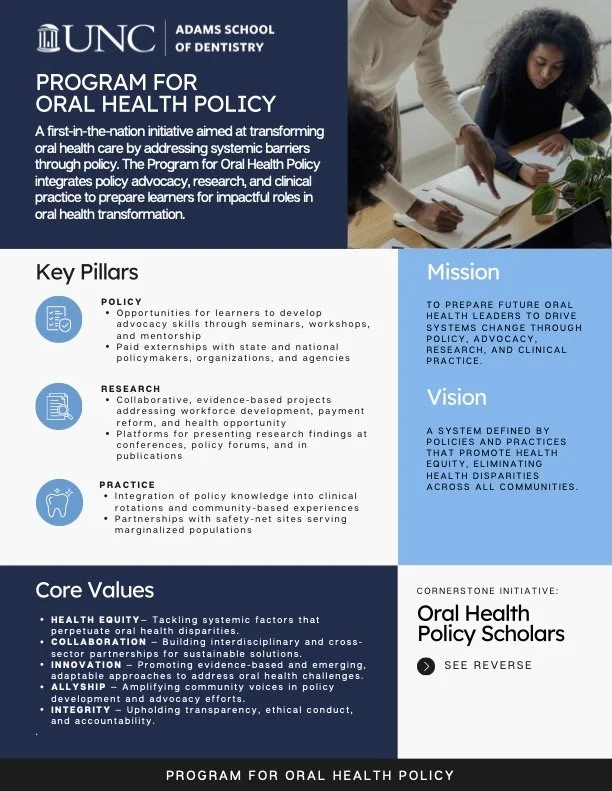
Click the image to download the flyer (pdf)
The UNC ASOD Program for Oral Health Policy is the first program of its kind housed within a U.S. dental school. Its design reflects UNC ASOD’s ACT curriculum (Advocate, Clinician, Thinker), which emphasizes the importance of preparing clinicians who understand how health systems operate and how policy influences patient care.
The program incorporates policy analysis, community-based learning, and systems-focused training. Students engage with local health departments, community health centers, state agencies, and organizations working on access and prevention efforts. This approach is intended to provide learners with a clearer understanding of the conditions influencing oral health delivery across the state.
The UNC Oral Health Policy Scholars
The Oral Health Policy Scholars Initiative serves as the program’s primary training experience. Selected through a rigorous application process, UNC ASOD student scholars participate in seminars, discussions with policymakers, and applied projects related to oral health access, prevention, coverage, and workforce development. Each scholar also completes an externship with a North Carolina legislative or executive office, regulatory agency, or payer organization, and presents at an annual policy symposium organized by the Program for Oral Health Policy.
The scholars’ work emphasizes practical exposure to how policies are developed and implemented. Scholars study legislative processes, regulatory frameworks, and data sources that guide decision-making. The initiative prepares participants to connect clinical knowledge with policy considerations and contribute to system-level improvements.
Scholars gain:
An understanding of oral health policy at state and national levels
Experience engaging with leaders and organizations involved in policy development
Skills related to communication, analysis, and systems thinking
Opportunities to develop applied projects relevant to North Carolina communities
How This Fits into Broader Trends
The Program for Oral Health Policy aligns with ongoing changes in oral health policy across the United States. Several states are exploring new workforce models, expanded dental benefits, updated reimbursement structures, and school-based prevention strategies. Research has shown these approaches can reduce emergency department visits for dental conditions, increase preventive service use, and improve access to care.
Decision-makers in North Carolina are participating in similar discussions. The program’s establishment provides a structured environment for preparing professionals who can contribute to these efforts and support the development of evidence-informed strategies.
Stay Connected
Individuals and organizations interested in the program’s work can follow updates, student projects, and future announcements on the program’s website. UNC ASOD will share additional information through upcoming communications, including a press release and opportunities for collaboration.
Learn more about the Program for Oral Health Policy
Meet the inaugural Oral Health Policy Scholars
Join our network to stay updated on the Scholars’ advocacy projects, upcoming seminars, and opportunities to share your expertise or serve as a mentor. Sign up by completing the short survey, here: https://unc.az1.qualtrics.com/jfe/form/SV_cNk6tn0ALBNpD6e
Follow and engage with UNC Adams School of Dentistry:
LinkedIn – UNC Adams School of Dentistry
Facebook – UNC Adams School of Dentistry
Contact Dr. Zachary Brian
Mailing Address:
UNC Adams School of Dentistry
Program for Oral Health Policy
Attn: Dr. Zachary Brian
385 S Columbia St.
Chapel Hill, NC, 27599
Email: zbrian@unc.edu
Disclaimer
This content was developed by the WNC Health Policy Initiative in consultation with people and organizations with connections to the health of people of Western North Carolina. Individual or organizational opinions, findings, conclusions, or recommendations are those of the relevant author(s)/interviewee(s) and do not necessarily reflect the view of the WNC Health Policy Initiative or its host institutions of the University of North Carolina Asheville (UNCA), Mountain Area Health Education Center (MAHEC) or our funders.