
WNC Health Policy Updates
Welcome to the WNC HPI Health Policy Updates Page
Here you will find brief weekly policy updates relevant to the work of the HPI and Western North Carolina, with a focus on state policies, and a list of state-level health policy resources. Note that this page is updated regularly, and at minimum weekly on Monday mornings.
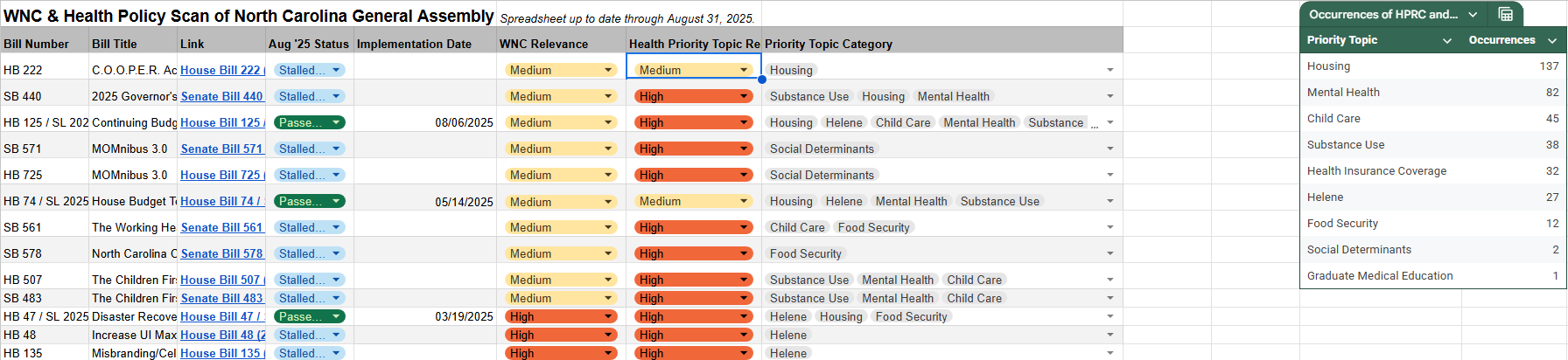
Click to view WNC & Health Policy Scan of NCGA 2025-2026 Legislation Session Spreadsheet
Download PDF of WNC & Health Policy Scan of NCGA 2025-2026 Legislation Session Research Summary
June 29, 2026
This week’s updates include:
Passage of the North Carolina State Budget:The North Carolina General Assembly successfully approved its first comprehensive state budget in nearly three years. The spending package has transitioned to Governor Josh Stein for final signature or veto.
2026 West Health-Gallup Healthcare Affordability Index. The 2026 West Health-Gallup Affordability Index reveals that U.S. adults' ability to afford healthcare has hit a five-year low, with only 49% of Americans now considered "cost secure." This decline is driven by rising medical costs, escalating insurance premiums, federal subsidy reductions for the ACA, and rampant inflation outpacing wages.
CMS Medicare prior authorization pilot sees mixed results: The rollout of the federal Wasteful and Inappropriate Service Reduction (WISER) six-state pilot program utilizing AI-powered prior authorization to screen 13 medical services for potential fraud and abuse has sparked widespread confusion, prolonged treatment delays, and forced some patients to travel out-of-state for care, and potentially creates financial incentives to deny legitimate medical claims while increasing administrative costs for taxpayers.
House Bill 565 (AI Regulation in Healthcare). Legislation has been introduced to create a regulatory safeguard to prevent hospitals and insurers from over-relying on automated algorithms to issue medical denials or artificially inflate Medicaid billing through AI-driven "upcoding,” mandating that qualified human professionals, rather than automated algorithms alone, must make all final insurance denial determinations. Despite these consumer protections, policy analysts note the bill falls short of addressing the underlying corporate incentive structures that reward high volumes of healthcare denials.
Buncombe Co. fentanyl mortality rankings. A June 2026 report from the North Carolina Office of the Chief Medical Examiner reveals that Buncombe County now has the fifth-highest fentanyl-related death rate per capita in the state.
House Bill 307 (Iryna's Law) results in jail overcrowding and delays substance use treatment. Since the implementation of Iryna’s Law, which alters pretrial release protocols, the Buncombe County detention facility has experienced an average daily population increase of roughly 70 incarcerated individuals compared to last year. Public health advocates warn that this can trap individuals with severe substance use disorders in overcrowded correctional environments rather than channeling them toward medical treatment.
NC General Assembly veto overrides in the news:
SB 153 – North Carolina Border Protection Act. Mandates that all state and local law enforcement agencies cooperate with federal authorities to enforce immigration policies. Public health experts warn that deputizing local law enforcement creates a profound chilling effect, instilling a fear of state actors that deters immigrant populations from seeking necessary medical care, reporting crimes, or participating in infectious disease tracking.
SB 227 and SB 558prohibit Diversity, Equity, and Inclusion (DEI) offices, trainings, and programmatic frameworks within K-12 public schools and higher education, respectively. Public health advocates warn that dismantling these programs actively undermines targeted school-based health initiatives designed to combat chronic student absenteeism and behavioral health disparities, and restricts minority recruitment pipelines and mentorship frameworks in higher ed created specifically to alleviate severe rural physician and nursing shortages.
Federal Public Health grant delays and language screening. The federal administration is withholding hundreds of millions of dollars in congressionally appropriated health grants while political appointees vet individual awards for alignment with executive priorities, interrupting critical funding earmarked for 988 suicide prevention networks, public health infrastructure, and local opioid recovery initiatives.
House Bill 437. Bars local municipalities from allowing ongoing unhoused encampments on public property and creates strict "drug-free homeless service zones" that elevate minor drug offenses near shelters to felonies. Local officials point out that the legislation imposes costly judicial and policing mandates on local municipalities without providing any new financial resources for shelter beds or permanent housing services.
NC Depts. of Health and Human Services and Information Technology have launched a joint rural digital infrastructure initiative to modernize rural medical infrastructure. The multi-year plan aims to bridge rural healthcare gaps by establishing a unified Health Information Exchange data system, facilitating secure clinical record sharing, and providing digital literacy training to tech-isolated rural residents.
Federal student loan caps and rural healthcare workforce shortages taking effect in July impose strict borrowing limits near $20,000 for graduate higher education, covering less than half the median annual tuition of standard clinical programs. Advocates warn that this move directly conflict with North Carolina's rural healthcare strategy, which relies heavily on expanding the deployment of advanced practice providers like Physician Assistants and Nurse Practitioners, and will make specialized medical training cost-prohibitive for rural students, severely exacerbating the state's existing workforce shortages.
Elevance Health pays $342M to CMS in midst of Medicare Advantage billing probe. In a major federal enforcement action, private insurer Elevance Health was compelled to pay $342 million to settle allegations that it consistently overcharged the government's Medicare Advantage program.
June 22, 2026
This week’s updates include:
North Carolina State Employee Vacancies and Low Pay. According to the state auditor, North Carolina faces a critical safety and operational risk with over 9,000 vacant state positions due to underfunded starting salaries.
The legislature's ongoing failure to pass timely budgets with cost-of-living adjustments severely hinders the state's ability to attract and retain essential workers.
Cutting these positions lightens the budget but, according to Auditor Dave Boliek, leaves critical safety and operational systems vulnerable.
North Carolina Senate Bill 1010 (Infrastructure Planning Centralization). Senate Bill 1010 proposes establishing a centralized, state-level committee appointed by top government officials to oversee long-term planning for roads, utilities, and hospitals. While proponents argue this single body will improve coordination and address social determinants of health more effectively, critics warn it strips local control and could create bureaucratic bottlenecks.
UNC Health Buncombe County Hospital Proposal. UNC Health has submitted plans to state regulators to build a new 92-bed hospital campus in Buncombe County to offer comprehensive emergency, psychiatric, and specialized medical services. This project is currently entering the state's competitive Certificate of Need review process while UNC Health concurrently appeals a prior 2025 regulatory decision regarding regional bed capacity.
North Carolina Senate Bill 1040 (Ambulatory and Rehab CON Repeal). Senate Bill 1040 seeks to improve healthcare affordability and access by completely repealing Certificate of Need requirements specifically for ambulatory surgical centers and inpatient rehabilitation facilities. The legislation is currently stalled in the Committee on Appropriations, highlighting a long-standing legislative gridlock surrounding healthcare deregulation.
North Carolina State Health Plan Restructuring. The North Carolina State Health Plan Board has initiated sweeping benefit restructurings in response to soaring costs, including upcoming votes on premium hikes and new third-party administrative contracts. The plan is transitioning to a three-tier coverage structure (preferred, access, and out-of-network) to tie state employee care and out-of-pocket costs directly to provider tiers and salary growth.
Appalachian Sustainable Agriculture Project (ASAP) Funding. The Appalachian Sustainable Agriculture Project received $400,000 in renewed funding from Blue Cross North Carolina to expand its Farm Fresh Produce Prescription Program. This initiative allows healthcare providers to prescribe tokens for fresh food at local farmers markets, aligning private healthcare investments with regional "food is medicine" public health strategies.
Medical Examiner Compensation and Coordinated Walkout. North Carolina medical examiners have not received a pay increase since 2015, remaining at a flat rate of $200 per completed case despite escalating workloads from the opioid crisis. To protest this low pay, medical examiners across 20 counties launched a “coordinated vacation,” threatening to severely stall law enforcement investigations and cause-of-death determinations. Senate Bill 847 was introduced to directly address the medical examiner shortage by legislating fee increases for completed death investigations. However, like broader state budget negotiations, the bill has stalled in the Appropriations Committee with no clear path forward.
North Carolina Senate Bill 153 (Immigration Enforcement Mandate). The General Assembly successfully overrode a gubernatorial veto to enact Senate Bill 153, which mandates that state law enforcement agencies undergo training to conduct federal immigration enforcement. Public health advocates warn this policy adds administrative burdens to an understaffed Highway Patrol and may dangerously deter immigrant communities from seeking emergency medical care.
Rural Mobile Opioid Treatment Units. The North Carolina Department of Health and Human Services is preparing to deploy six fully certified, mobile opioid treatment centers to deliver methadone and counseling to underserved rural areas. Unlike emergency overdose tools like naloxone, these mobile units operate under strict clinical supervision as a long-term harm reduction strategy for individuals facing transportation barriers.
North Carolina Senate Bill 630 (School Mental Health Support). Senate Bill 630 is a stalled legislative proposal designed to allocate $50 million for public schools to hire mental health professionals and an additional $50 million for a student loan repayment program. The bill targets severe youth mental health shortages by financially incentivizing UNC system graduates to practice in high-need, rural counties.
June 15, 2026
This past week’s updates included:
Federal One Big Bill Act (Medicaid Work Requirements & Administrative Changes). The federal "One Big Bill Act" introduces sweeping administrative modifications to Medicaid, including the implementation of strict work reporting requirements—demanding at least 80 hours a month of employment, schooling, or volunteering—and increasing eligibility renewals to twice a year. In response, North Carolina’s Medicaid leadership is leveraging the Government Data Analytics Center (GDAC) to automatically import data from various state agencies to streamline eligibility determinations and ease administrative burdens for eligible participants and county DSS offices.
Center for Medicaid Services (CMS) "Medically Frail" Exemption Rule. On June 3rd, the Center for Medicaid Services (CMS) released a lengthy policy document that shift eligibility from a simple diagnosis-based classification to one requiring strict proof of a functional inability to work. This change makes it significantly harder for county health departments to verify exemptions and for vulnerable populations to keep coverage..
North Carolina House Bill 696 (Medicaid Rebase Bill). Signed into law in late April, House Bill 696 establishes the state's "Medicaid rebase," the funding necessary to cover Medicaid through the end of the year in the absence of a fully passed state budget. This bill bans the use of self-attestation as sole proof of Medicaid eligibility, and rolls back previously extended state coverage for an estimated 27,000 lawfully present immigrant pregnant women and children starting in October.
North Carolina House Bill 1076 (Innovations Waitlist Reduction Act). Introduced in April, House Bill 1076 proposes redirecting state funds away from private school vouchers for high-income families to provide $240 million for 6,635 new Innovations Waiver slots. The goal is to drastically reduce a years-long waitlist for home and community-based services for individuals with intellectual and developmental disabilities.
North Carolina Senate Bill 978 (Hospital Transaction Review & Whistleblower Protections). Filed on April 30th, Senate Bill 978 grants state officials the authority to review major hospital transactions, caps nonprofit hospital CEO pay, and restricts employee non-compete clauses. It also establishes robust whistleblower protections for healthcare staff, inspired by past corporate retaliation issues at Asheville's Mission Hospital.
The Dissolution of the Federal SAVE Student Loan Repayment Plan. Following federal court blocks, the income-driven SAVE repayment plan was terminated, forcing millions of borrowers to transition to alternative payment structures. Policy experts warn that losing this affordable repayment pathway adds regional financial strain and may deter students from entering the healthcare field during an active workforce shortage.
June 8, 2026
This past week included:
NCDHHS announced $10 million in EMS workforce investments through the NC Rural Health Transformation Program. The funding will support 39 local EMS agencies and expand Mobile Integrated Health programs that connect residents with behavioral health, substance use, and preventive services outside of traditional emergency settings.
House Bill 1104, Improve IVC Process and Enhance Public Safety, continues moving through the General Assembly and would expand coordination, reporting, and oversight within North Carolina's involuntary commitment system.
A new national report identified five North Carolina rural hospitals as being at risk of closure. The analysis, produced by the Center for Healthcare Quality and Payment Reform, highlights ongoing challenges related to staffing shortages, reimbursement pressures, and financial instability.
NCDHHS announced that approximately $121 million in assistance will be distributed during the first round of 2026 SUN payments. The program helps families purchase food during summer months when school meals are unavailable and serves as one of the state's largest seasonal food security initiatives.
State employees and retirees may see changes to health insurance costs under proposals from the State Health Plan. Current discussions would increase premiums for some Medicare Advantage retirees while potentially lowering costs for certain active employees. The proposals reflect ongoing efforts to address long-term financial pressures facing the State Health Plan.
Bills to Watch
House Bill 1104
Purpose: Would expand coordination, reporting requirements, and system oversight related to North Carolina's involuntary commitment process.
Current Status: Continues moving through the General Assembly following recommendations from the House Select Committee on Involuntary Commitment and Public Safety.
House Bill 730
Purpose: Addresses data center development, utility planning, and energy infrastructure requirements, including provisions related to future power generation and resource use.
Current Status: Advanced through the House.
House Bill 1115
Purpose: Expands North Carolina's cooperation with federal immigration enforcement through additional 287(g) participation requirements for local agencies.
Current Status: Under continued legislative consideration, with advocates and researchers debating potential implications for healthcare access, community trust, and public health outcomes
June 1, 2026
This past week included:
Title X funding uncertainty continued to draw national attention. Title X is the nation's only federal program dedicated to family planning and reproductive health services, supporting contraception, STI testing, cancer screenings, and preventive care for low-income patients. Health advocates warn that funding disruptions could reduce access to care, particularly in rural and underserved communities where safety-net providers play an important role.
Recent reporting from North Carolina Health News found that families often face significant legal and financial barriers when pursuing neglect or abuse claims against nursing homes. As a result, enforcement of quality standards frequently depends more on regulatory oversight and inspections than on litigation outcomes.
CMS finalized updates to the federal Independent Dispute Resolution process under the No Surprises Act. The rule largely affects how insurers and healthcare providers resolve payment disputes behind the scenes and does not change existing protections against surprise medical bills.
Families preparing for the next school year are encouraged to complete required kindergarten health assessments. North Carolina law requires children entering school for the first time to receive a health assessment and submit documentation before attendance. These visits also provide opportunities for immunizations, developmental screenings, and other preventive services before the school year begins.
HPI & WNC-Relevant State Policy Updates and Resources
Read below for weekly updates on state-level policies relevant to the WNC HPI and Western North Carolina. The following updates employ the use of generative AI tools, and are edited and analyzed to reflect real-time policy changes and decisions.
For further analysis, tune into the accompanying WNC HPI weekly Health Policy Updates podcast.
Click here for more NC Policy News Resources.
Past Updates
-
May 27, 2026
This past week included:
North Carolina joineda multistate lawsuit challenging new federal student loan limits for graduate nursing programs. Attorney General Jeff Jackson argued the U.S. Department of Education unlawfully narrowed the definition of "professional degree.” Supporters of the lawsuit warn that the policy may worsen existing healthcare workforce shortages, particularly in rural states such as North Carolina.
Bills to Watch
Primary Sponsor: Jim Burgin (R-Harnett)
Purpose: Requires hospital authority boards to comply with North Carolina open meetings laws, while also making broader changes to hospital authority governance and commissioner appointments.
Current Status: Re-referred to the Senate Committee on Appropriations/Base Budget on May 4, 2026.
Primary Sponsor: Jim Burgin (R-Harnett)
Purpose: Would expand state oversight of major hospital transactions, create whistleblower protections for healthcare workers, limit noncompete agreements, and cap nonprofit hospital CEO compensation at 400 times the compensation of the lowest-paid full-time employee.
Current Status: Referred to the Senate Rules and Operations Committee on May 4, 2026, where it awaits further consideration.
Primary Sponsor(s): Reps. Tim Reeder (R-Pitt), Kristin Baker (R-Cabarrus), Donny Lambeth (R-Forsyth), and Grant Campbell (R-Cabarrus). The bill has since been modified in the Senate, with Sen. Amy Galey (R-Alamance) serving as a leading advocate.
Purpose: Would prohibit insurers and Medicaid prepaid health plans from using artificial intelligence as the sole basis for denying healthcare claims or prior authorization requests. The bill also seeks to prevent healthcare providers from using AI to "upcode" diagnoses, procedures, or billing claims in ways that increase reimbursement without appropriate clinical justification.
Current Status: The bill is currently under consideration in the Senate Health Care Committee and, if approved, would move to the Senate Rules and Operations Committee.
Primary Sponsors: Sen. Jim Burgin (R-Harnett), Sen. Benton Sawrey (R-Johnston), and Sen. Gale Adcock (D-Wake).
Purpose: Would require state and local inspectors to recognize the results of a previously completed inspection conducted within the prior three months rather than requiring duplicative inspections. Supporters argue the bill would reduce administrative burden and allow regulators to focus resources on facilities with greater compliance concerns.
Current Status: Referred to Senate committee for consideration during the 2026 short session.
An Ebola treatment center in eastern Congowas set on fire after health officials prevented family members from retrieving the body of a community member suspected of dying from Ebola. The attack occurred amid disputes over burial practices, as Ebola response protocols often restrict traditional funeral rites because the virus remains highly contagious after death.
Walmart reported absorbing roughly $175 million in unexpected fuel costs during the first quarter of 2026, and isthus planning to raise its retail prices for consumers The retailer reported a revenue rise of 7.3% in the earnings report as well.
On May 22, the U.S. Department of Health and Human Services formally renewed the President's Council on Sports, Fitness and Nutritionas part of Executive Order (EO) 14327. The council will continue advising the administration on efforts to promote youth sports participation, physical activity, and nutrition initiatives.
May 20, 2026
This past week included:
Vice President JD Vance escalated the administration’s federal Medicaid anti-fraud effort, warning states that federal Medicaid funding could be withheld if states fail to cooperate with federal investigations. California and Minnesota are currently the only confirmed states to face withheld or deferred Medicaid-related funding, though all 50 states reportedly received warning letters from HHS officials.
Governor Josh Stein proclaimed May 18–22 as North Carolina Heat Safety Week as the state prepares for another summer of extreme temperatures. North Carolina recorded more than 5,700 heat-related emergency department visits in 2025.
Mission Hospital’s proposed 95-bed expansion continued drawing scrutinyafter reporting showed projected staffing increases remain relatively small compared to planned bed growth. Mission also announced more than $10 million in employee pay raises aimed at improving recruitment and retention across Western North Carolina.
North Carolina’s revised revenue forecast added an additional $2.6 billion to the state’s budget outlookfollowing stronger-than-expected tax returns. The updated forecast could affect ongoing negotiations surrounding healthcare funding, workforce investments, Medicaid policy, and rural health priorities.
House Bill 1154, which would expand the FarmSHARE Food Hub Program and Double Up Food Bucks initiative, advanced through the North Carolina House committee process. Supporters say the proposal could improve food access and systems across Western North Carolina.
Governor Josh Stein announced additional policy priorities related to opioid response, emergency preparedness, and housing affordability. Executive Order No. 36 directs state agencies to include expanded medication-assisted treatment in correctional settings and a new Fentanyl Control Unit. Importantly, the order also directs agencies to coordinate statewide housing affordability efforts.
Public health officials continued monitoring international outbreaks involving the Andes variant of Hantavirus and the Bundibugyo strain of Ebola. The World Health Organization (WHO) recently declared Ebola an international emergency.
May 13, 2026
This past week included:
Federal officials halted publication of several FDA vaccine safety studies. The pause affects studies on COVID-19 and shingles vaccines and has raised broader concerns about how vaccine safety data is reviewed, communicated, and incorporated into federal public health guidance.
North Carolina lawmakers continue working through the state’s Medicaid “rebase.” The funding measure was intended to stabilize Medicaid coverage for more than 3 million North Carolinians, though policymakers acknowledge additional fixes may still be needed in the months ahead.
Senate Bill 550would require mental health training for youth sports coaches statewide. Supporters say coaches are often among the first adults to recognize emotional distress in young people, particularly in rural communities with limited behavioral health access.
Buncombe County lawmakers proposed redirecting private school voucher funding toward child care and teacher pay.
North Carolina House members introduced a “dynamic pricing” bill, which aims to prohibit retailers from using personal or demographic data to set individualized food prices.
Executive Order 14398may affect federally funded healthcare and workforce programs. The order creates new federal contracting requirements related to race- and ethnicity-based program criteria.
Redistricting
Across the South, redistricting intensified following the Supreme Court’s April ruling in Louisiana v. Callais, which narrowed how Section 2 of the Voting Rights Act can be used to challenge racial vote dilution.
Tennessee:Lawmakers approved a new congressional map splitting Memphis and Shelby County into multiple districts, prompting lawsuits from the NAACP and voting rights groupswho argue the changes weaken Black political representation ahead of the 2026 elections.
Virginia: The Virginia Supreme Court struck down a proposed congressional redistricting amendmentthis month, leaving the state’s current maps in place for the 2026 elections. The U.S. Supreme Court later declined to intervene, allowing the existing district maps to remain through the 2026 election cycle and further underscoring the growing role state courts play in election oversight and partisan gerrymandering disputes.
South Carolina: South Carolina Senators rejected a push to discuss changes that could further weaken representation in the state’s only Democratic-leaning district. Some leaders within the South Carolina GOP believe the measure is legally unnecessary.
May 5th, 2026
This Past Week Included
On Friday, May 1st, NC selected regional leaders for “NC ROOTS Hubs” networks as part of the NC Rural Health Transformation. In WNC, Impact Health was named to serve as the hub lead.
Two dozen students from 14 counties gathered at the General Assembly Wednesday April 29th to support H.B. 430 (“Solly’s Law”), which would raise the tobacco sales age from 18 to 21 and require retailers to obtain state permits to sell those products.
New data from the Center of Budget and Policy Priorities shows millions of Americans are losing access to food assistance under changes tied to HR1.
Drugmakers have filed an emergency appeal asking the Court to restore access to mifepristone by mail, after a federal appeals court ruled that the medication must once again be picked up in person.
The U.S. Department of Justice recently moved to reclassify certain cannabis products, including FDA-approved marijuana medications and state-regulated medical marijuana, to a less restrictive category (Schedule 1 to schedule 3) under federal law.
Following the approval of 95 acute care beds for Mission Health, Advent Health formally filed an appeal of challenging the approval. The appeal is now moving into the state’s administrative review system, where a ruling could take several months.
Multiple cases of the hantavirus, known to be transmitted through rodents to humans, were reported on an international cruise ship. The outbreak is being monitored, although many of the passengers have now arrived back to the mainland.
-
April 30, 2026
This Past Week Included
Congressional hearings involving Health Secretary Robert F. Kennedy brought renewed attention to vaccine confidence, federal health spending, and Medicaid policy direction. While no new policies were enacted, the hearings demonstrated a continued sense of ambiguity, which may shape funding priorities and public trust nationwide.
Medicaid Shortfall Package
Lawmakers returned to Raleigh for the April 21st Short Session, and quickly advanced a bipartisan package to address a $319 million Medicaid shortfall through the end of the fiscal year. Governor Stein signed the bill on April 30th.
The measure draws from reserve funds, but also introduces new oversight provisions and eligibility changes. The funding package maintains coverage for over 3 million NorthCarolinians. However, new provisions include more frequent eligibility checks, alignment with future work requirements, and increased copays.
Property Tax Reduction and Reform
The House Select Committee on Property Tax Reduction and Reform has temporarily halted efforts to modify hospital tax structures. The committee had previously proposed two different types of tax reforms. The first proposal would have cut nonprofit hospitals’ 100 percent property tax exemption in half; the second section would have lowered how much large hospital systems could recoup in sales taxes.
The same committee is advancing proposals that could limit local property tax flexibility and close development-related tax loopholes. These measures may appear on the November ballot as a constitutional amendment.
Duke Energy
The North Carolina Utilities Commission directed Duke Energy to pause new solar projects until 2026 or later. The proposal comes on the back of an elimination of the 2030 carbon reduction target, and changes to federal solar tax incentives.
Duke Energy held a public hearing in Morganton on April 28. This hearing focused on a proposed residential rate increase of up to 18%.
Swain County approved a 12-month moratorium on new data centers, joining other WNC communities in pausing development. Concerns include energy demand, water usage, and long-term community impacts, especially as AI-related infrastructure expands.
A virtual screening on April 28 and an in-person event on May 1 in Hendersonville showcased the role of North Carolina’s HOP program.
April 20, 2026
This Past Week Included
Lawmakers return to Raleigh for the short session on April 21 with a $319 million Medicaid funding gap still unresolved. Budget negotiations are expected to focus on Medicaid sustainability, state employee pay, and school infrastructure.
NC Drought
Nearly all of North Carolina is experiencing severe drought conditions, with 82 counties designated as natural disaster areas. Voluntary water restrictions are emerging in some regions, while others are relying on infrastructure resilience.
Dry, compacted soils increase the risk of flash flooding when heavy rains return, particularly during El Niño cycles.
New findings this spring suggest North Carolina’s school cellphone restrictions are only partly effective, prompting renewed calls for stricter rules. North Carolina school districts currently operates under the provisions outlined in House Bill 959 (H959)
A proposed expansion of Flock license plate reader cameras, tied to a $1.1 million federal grant secured by Congressman Chuck Edwards, has been delayed following public pushback. Concerns include privacy, mental health impacts, and limited evidence of long-term safety benefits. The proposal is under continued City Council review.
A new Behavioral health urgent care facility was announced in Robeson County by the NCDHHS.
Public hearings on Duke Energy’s proposed rate increase continue in Haywood County and Burke County. Residents have raised concerns about affordability and cumulative cost burden.
April 13, 2026
This Past Week Included
Ongoing burn bans continue, as North Carolina faces severe drought.
The North Carolina Utilities Commission is reviewing a proposed 18% rate increase by Duke Energy. Many residents are describing difficult tradeoffs between paying utility bills and affording essentials like food and medication.
A recent review has revealed that North Carolina continues to face a degree shortfall. Currently, job growth exceeds the number of residents with required credentials. Within the Nursing profession, there is an annual gap of 806 degrees.
Maggie Woods was named Director of the Rural Health Transformation Program (RHTP). Woods has a background in broadband policy and will seemingly emphasize the growing role of connectivity and infrastructure in rural health outcomes.
The documentary “The Root of Good Health” will premiere April 22. The documentary highlights the impact of North Carolina’s Healthy Opportunities Pilot (HOP). The program demonstrated improved outcomes and reduced Medicaid costs by approximately $1,000 per enrollee per year by addressing needs like housing, food, and transportation.
The North Carolina Department of Health and Human Services launched a new data toolkit to support injury and violence prevention efforts.
April 6, 2026
This Past Week Included
Rep. Chuck Edwards proposes stronger federal hospital oversight following Mission Hospital's repeated failures to meet service delivery standards. Edwards’ proposed legislation would expand CMS enforcement powers for hospitals that are violators. Chuck Edwards aims to allow penalties and intervention short of cutting Medicare and Medicaid funding after repeated “Immediate Jeopardy” citations.
The Rural Emergency Hospital model has emerged as a pathway to sustain rural access in North Carolina. A proposal to convert Martin General Hospital in Martin County, NC into the state’s first REH is currently being examined. This center would maintain 24/7 emergency and outpatient services without inpatient care, offering a potential lifeline for struggling rural hospitals.
Wake County plans to cut its education budget by millions of dollars. Officials note that the ongoing lack of a finalized state budget, population declines, and workforce shortages all contributed to the decrease.
The North Carolina Cannabis Working Group met on April 6th to discuss youth cannabis youth and policy options for curbing usage. The work group was started in July of 2025, and seeks to explore the issues associated with an unregulated cannabis market in NC, particularly as it pertains to youth.
-
March 30, 2026
This Past Week Included
Wildfire risk prompts burn bans across Western North Carolina, raising air quality and public safety concerns during dry spring conditions
Rising global conflict contributes to higher fuel prices in WNC, increasing transportation barriers to work, food access, and healthcare in rural communities
Senate leadership transition looms as Phil Berger faces political shifts, raising questions about future state policy priorities
New analysis highlights growing strain of long-term healthcare needs within North Carolina’s prison system, with rising demand among aging incarcerated populations and a limited number of beds.
March 23, 2026
This Past Week Included
Mission Hospital submits corrective plan after federal “Immediate Jeopardy” finding; must meet CMS compliance standards by July or risk losing Medicare and Medicaid funding, raising major concerns for regional access to specialized and emergency care in WNC
NC lawmakers are considering changes to nonprofit hospital tax exemptions, citing concerns that hospitals receive around $1.8B annually in tax breaks without proportional charity care, with potential impacts on rural hospital stability and service capacity in WNC
Lawmakers raised concerns over rapid growth in autism therapy spending,prompting discussions about cost drivers, oversight, and long-term sustainability within North Carolina’s Medicaid program
State budget projections indicate slowing growth in federal Medicaid funding, with some estimates dropping from $19B to $17.9B, increasing concern among lawmakers about potential shortfalls before the end of the fiscal year
March 16, 2026
This Past Week Included
The WNC Health Policy Initiative hosted its 2026 Legislative Summit at UNC Asheville, bringing together about 130 policymakers, healthcare leaders, and community stakeholders to discuss access to care, healthcare workforce shortages, and social drivers of health. Speakers included Lt. Gov. Rachel Hunt, Dogwood Health Trust CEO Susan Mims, MAHEC CEO William Hathaway, UNC Asheville Chancellor Kimberly van Noort, and Impact Health CEO Laurie Stradley.
A bipartisan housing proposal passed in the U.S. Senate aimed at increasing housing supply through construction incentives and limits on large institutional homebuyers.
North Carolina officials announced the State Health Plan will open a competitive bidding process for its claims administration and pharmacy benefit contracts rather than extending current agreements with Aetna and CVS Caremark.
North Carolina officials reported early progress on the Children and Families Specialty Plan, a Medicaid program designed to coordinate healthcare for youth involved in the foster care system. Since launching in December 2025, the program has enrolled more than 32,000 youth and reduced the average time needed to arrange services from about 45 days to 16 days.
March 9, 2026
This past week included:
Primary election results were tallied on March 3, 2026. Here are some pertinent results:
U.S. Senate: Democrat Roy Cooper and Republican Michael Whatley won their respective primaries and will face each other in the general election to replace the seat currently held by Thom Tillis.
U.S. House District 11: Incumbent Republican Chuck Edwards and Democrat Eric Ager advanced from their primaries and will compete in November to represent Western North Carolina in Congress.
Lawmakers on the North Carolina Child Fatality Task Force voted to support restoring funding for the North Carolina Perinatal Quality Collaborative, which lost funding during a 2025 budget dispute. Legislators from both parties have expressed interest in restoring the program’s $905,000 annual budget during the upcoming legislative session.
North Carolina’s State Health Plan introduced a new benefit that would allow surgeries such as joint replacements and cardiac procedures to be performed with no out-of-pocket cost when members use providers through the Lantern specialty care platform.
New research from North Carolina State University suggests that states relying more heavily on sales tax revenue tended to lift COVID-19 stay-at-home orders earlier than states with other tax structures.
The federal government has proposed updates to registration requirements in the System for Award Management (SAM) for organizations receiving federal grants or cooperative agreements. Public comments on the proposal are open through March 30.
The letter-of-intent deadline has passed for organizations seeking to serve as Western North Carolina’s ROOTS Hub under the NC Rural Health Transformation Program, which could bring up to $1 billion in federal funding to North Carolina over five years. Full applications are due April 2.
March 2, 2026
This past week included:
NC Medicaid DirectorJay Ludlam announced his departure from the NC Department of Health and Human Services, raising questions about leadership continuity as Medicaid operational reforms (especially behavioral health expansions) continue.
Early voting for the 2026 March 3 primary concluded, and health policy remains a topic in several statewide and district races; voters can review sample ballots to see related initiatives and candidate positions.
Health organizations across NC continue applying to serve as NC ROOTS Hubs, an initiative aimed at expanding regional behavioral health coordination, integrating social and medical care, and boosting community resilience.
North Carolina lawmakers continued reviewing legislative proposals that would modify how involuntary outpatient commitment is used.
Local and state health departments have emphasized the importance of maintaining measles vaccination availability and community outreach in areas with identified under-vaccination.
-
February 23, 2026
This past week included:
North Carolina released progress on its 2025-2027 Behavioral Health Strategic Plan, highlighting early expansions in mental health and substance use treatment services, while noting ongoing access gaps.
State officials reported rising measles cases statewide and urged vaccination to prevent further spread, reaffirming concerns about declining childhood immunization rates.
North Carolina remains without an enacted state budget for the 2025-2027 biennium as of mid-February 2026. This delay continues to create uncertainty in Medicaid planning, staffing for health programs, and long-range health policy implementation.
State Representative Deb Butler (D-New Hanover) and members of the NC Progressive House Caucus proposed a constitutional amendment to withhold pay from legislators until a state budget is passed in hopes of breaking the budget impasse.
Federal officials (HHS/CMS) released the proposed 2027 ACA Marketplace “Notice of Benefit and Payment Parameters”, signaling potential changes influencing premiums, eligibility verification, insurer participation standards, and plan design flexibility for North Carolina residents.
February 16, 2026
This past week included:
North Carolina’s state budget impasse continued as lawmakers failed to reach an agreement, keeping the state operating under last year’s funding levels.
Members of the NC Progressive House Caucus proposed a bill that would withhold legislators' pay until a budget is passed.
Early voting for North Carolina’s March 3 primary election began statewide, alongside renewed attention to federal voting legislation.
The U.S. House–passed SAVE Act would require documentary proof of citizenship to register to vote, such as a passport or birth certificate. The measure could create barriers for newly married voters, people who have recently moved, and first-time voters if enacted.
The Centers for Medicare & Medicaid Services released a proposed 2027 Notice of Benefit and Payment Parameters for the Affordable Care Act. The proposal outlines stricter eligibility verification, reduced enrollment flexibility, and limits on federal subsidy spending. If finalized, the rule could reduce national ACA enrollment by an estimated 1.2–2 million people.
Measles cases continue to rise in North Carolina. Approximately 21 cases have been reported statewide and at least seven have been confirmed in Buncombe County. State health officials have expanded vaccination outreach and public exposure notifications. The MMR vaccine remains the most effective tool for preventing further spread, particularly among unvaccinated children and adults without documented immunity.
February 9, 2026
This past week included:
The North Carolina Department of Justice announced a $17.85 million settlement with generic drug manufacturers Lannett and Bausch Health over allegations of long-running price-fixing that increased prescription drug costs. North Carolina also joined a multistate lawsuit against Novartis and its Sandoz subsidiary alleging similar anticompetitive practices.
Governor Josh Stein signed Executive Order No. 33, directing state agencies to improve coordination between North Carolina’s behavioral health system and the criminal justice system. The order focuses on crisis response, behavioral health workforce capacity, involuntary commitment processes, and access to treatment in justice-involved settings.
Measles cases continued to increase statewide, with NCDHHS reporting approximately 15–17 cases since late December and the first hospitalization of the current outbreak. Cases have been identified in multiple regions, including Western North Carolina. NCDHHS expanded vaccination outreach and public exposure notifications.
The Governor proclaimed February 2026 as Heart Health Awareness Month and February 6 as National Wear Red Day.
With the March 3, 2026 primary election approaching, North Carolina entered a heightened phase of campaign activity and voter engagement. Election administration and voter access issues remained active topics in state policy discussions.
February 2, 2026
This past week included:
The North Carolina Department of Health and Human Services (NCDHHS) extended temporary Medicaid flexibilities for beneficiaries due to the January winter storm. These provisions included early prescription refills and adjusted submission protocols for pharmacy claims to ensure access during the state of emergency.
State Medicaid officials have begun discussing strategies for covering rising administrative costs and preparing for federal Medicaid work requirements that could take effect under recent federal law changes. Proposed options include assessing provider taxes, shifting costs to insurers, and tapping state savings.
Funding shifts have led to changes in the NC Medicaid Member Ombudsman program. As of January 2026, contract services previously run by Legal Aid ended due to budget shortfalls, and essential ombudsman functions moved directly under NCDHHS with some scaled-back services.
New federal Medicaid policy changes under the H.R. 1 reconciliation law are starting to roll out with implications for eligibility and operation of NC Medicaid.
-
January 26, 2026
This past week included:
Updated Medicaid fee schedules and provider payments took effect with the reversal of prior reimbursement rate cuts, ensuring providers receive full pre-cut payment rates. However, the underlying state budget gap for Medicaid funding remains unresolved, placing pressure on legislators to reach a long-term fiscal solution.
North Carolina’s largest health systems halted gender-affirming care for youth under age 19, leaving fewer treatment options for transgender adolescents and raising concerns among advocates about continuity of care and access to services for this population.
State officials began planning a proposed $1 billion rural health initiative, outlining steps to deploy federal funds to improve care in rural counties while lawmakers discuss equity and access considerations.
State health officials outlined early implementation plans for a federal Rural Health Transformation Program, as North Carolina prepares to utilize an initial $213 million award from the program to improve rural health care access, address provider shortages, and expand services in underserved communities.
January 12, 2026
This past week included:
North Carolina officials urged the General Assembly to finalize the long-delayed state budget, as the state continues operating under last year’s funding levels amid disputes over income tax cuts and pay raises.
NCDHHS reported an additional measles case in Rutherford County, bringing North Carolina’s total to five cases since late December. Health officials urged vaccination for all unvaccinated individuals age 1+ and emphasized immunization as the most effective prevention strategy.
Gov. Josh Stein highlighted Hurricane Helene housing recovery efforts in Western North Carolina, including a $300,000 state grant to repair at least 20 storm-damaged homes and an additional $18 million approved to expand volunteer-based home repair programs.
After the U.S. Department of Health and Human Services froze child care and family assistance grants in five states, concerns spread in North Carolina. However, AG Jeff Jackson and NCDHHS Secretary Dev Sangvai said no freeze has been issued for NC, and the Jan. 5 warning does not apply to the state’s reimbursement-based subsidy system.
A bill to eliminate DEI programs at public universities (SB 558) remains stalled, as the NC House has repeatedly delayed a veto override vote due to a narrow Republican margin. Legislative leaders continue holding the bill and other vetoed measures on the calendar pending favorable vote conditions.
-
December 22, 2025
This past week included:
NCDHHS was directed to reverse the October Medicaid reimbursement rate reductions last week. State officials continued to warn that a roughly $319 million Medicaid funding gap remains without legislative action.
State Health Plan leaders emphasized a shift toward preventive and population-health investments as part of broader cost-containment strategies for 2026.
Housing affordability and supply shortages continue to dominate policy discussions in North Carolina, drawing sustained attention from state and local leaders.
December 15, 2025
This past week included:
Gov. Josh Stein halted planned Medicaid provider rate cuts, and restored reimbursement levels after legal and legislative challenges.
A North Carolina Health News investigation reported that some hospitals are charging patients separate fees for completing health questionnaires.
The North Carolina General Assembly will not hold additional votes in 2025 and will continue to operate without a full state budget. Key investments and adjustments across health, Medicaid, and public health programs have been delayed.
December 8, 2025
This past week included:
A federal committee voted to end the longstanding universal birth-dose recommendation for the hepatitis B vaccine for newborns.
Hidden PFAS pollution uncovered in NC, while EPA proposes a rollback in reporting for businesses that make or use PFAFS.
Iryana’s law was enacted as House Bill 307 and officially took effect on December 1, 2025. Governor Stein criticizes parts of the bill.
NCDHHS launches the Children and Families Specialty Plan (CFSP), a statewide Medicaid-managed care plan specifically for children, youth, and young adults currently or formerly served by the child welfare system.
NCDHHS launches Student Loan Repayment Program designed to bolster the mental health, substance use, I/DD and TBI workforce.
The State Health Plan announced that its projected 2025 deficit has now been resolved.
December 1, 2025
This past week included:
NCDHHS advanced a $1 billion Rural Health Transformation proposal, submitting its formal application to CMS.
A Wake County court temporarily halted Medicaid rate cuts to intensive autism therapy services.
North Carolina Department of Health and Human Services (NCDHHS) opened the state’s second mobile opioid-treatment program.
-
November 24, 2025
This past week included:
North Carolina submitted its application to draw down up to $200 million through the federal Rural Health Transformation Program.
A federal court upheld North Carolina’s 2023 congressional maps, allowing the redrawn districts to remain in place for upcoming elections.
Governor Stein, NCDHHS, and the Governor’s Recovery Office for Western NC (GROW NC) announced the expansion of WNC Thrive. The initiative increases access to after-school programs, weekend activities, mental-health supports, and summer camp opportunities across 22 Western NC counties.
A New Bern ophthalmologist filed a constitutional challenge to North Carolina’s Certificate-of-Need (CON) law, arguing the regulations violate economic-liberty protections.
North Carolina remains without a full state budget. The ongoing legislative impasse keeps the state operating under last year’s funding levels, slowing decisions for Medicaid and other priority programs.
November 10, 2025
Governor Josh Stein urged NC lawmakers to convene a special session to address shortfalls in funding for Medicaid. The session is scheduled for November 17th.
State Treasurer Brad Briner and the State Employees Association of NC (SEANC) filed court documents in support of a lawsuit challenging the state’s certificate-of-need health care restrictions. A court hearing is scheduled for November 18th.
The NC Department of Health and Human Services (DHHS) announced that partial payments were uploaded onto EBT cards for SNAP beneficiaries on Friday, November 7th.
The North Carolina Chamber of Commerce and Blue Cross and Blue Shield of North Carolina announced the Carolina HealthWorks program, a new health insurance plan for small businesses (2-50 employees) who are members of the Chamber or local chambers.
-
October 27, 2025
North Carolina state legislators remain stalled in negotiations on Medicaid. The Charlotte News & Observer reports that lawmakers are unlikely to reach an agreement on Medicaid funding in October. By the time they convene in November, there will be more information about the impact of the October 1st cuts to reimbursement rates.
The NC Legislature voted along party lines to approve a new congressional map for NC, which would add one new congressional district. The new district increases the number of districts in which Republicans have an advantage from 10 to 11, out of 14 congressional seats in NC.
The full NC Legislature re-convenes on November 17th.
October 20, 2025
The North Carolina State Health Plan's exclusion of coverage for transition-related treatments typically sought by transgender patients was reinstated last Wednesday, after a 4th circuit court vacated a trial judge’s 2022 decision to block the exclusion (Kadel v. Folwell).
Though there was concern about discontinuation of Supplemental Nutrition Assistance Program (SNAP) benefits, the NC Department of Health and Human Services assured the public that they will continue to be paid in October. The DHHS encourages households to continue to apply.
Legislators return to session this week, October 20, 2025. Major issues are the state budget and Medicaid funding. The chambers are in disagreement about the timeline for tax cuts and the establishment of a new children’s hospital. According to the National Conference of State Legislatures, North Carolina is one of two states that has not enacted a budget for the current fiscal year.
October 13, 2025
This past week included:
Governor Stein and the NC Department of Health and Human Services announced benefits to over 2.5 million North Carolinians after 15 months of a medical debt elimination effort, which came out of the Healthcare Access and Stabilization Program, which was approved by state legislators in 2023.
Governor Stein proclaimed October 12-17 Health Care Security and Safety Week.
The NC Department of Health and Human Services is invitinginput on its Rural Health Transformation Plan application to the Centers for Medicaid and Medicare Services . Western North Carolina organizations and individuals may submit input here by October 15th. For reference, the WNC Health Network shared their comments.
Legislators return to session on October 20, 2025.
October 6, 2025
This past week included:
The NC Legislature adjourned until late October without the House and Senate agreeing on a Medicaid Rebase bill. The two chambers passed their own budget bills but did not agree on funding for a UNC Duke Children’s Hospital.
Medicaid reimbursement rate cuts went into effect: The North Carolina Department of Health and Human Services (NCDHHS) announced cuts to Medicaid reimbursement rates effective October 1, 2025.
Governor Stein signed HB 307 (“Iryna’s Law”) into law, recognizing additional measures to review cases and concerns over some aspects of the bill, including the last-minute addition of firing squads as a form of execution. He encourages a comprehensive public safety package.
The NC Department of Health and Human Services is invitinginput on its Rural Health Transformation Plan application to the Centers for Medicaid and Medicare Services . Western North Carolina organizations and individuals may submit input here by October 15th. For reference, the WNC Health Network shared their comments.
-
September 29, 2025
Selected WNC-Relevant State Health Policy Updates:
HB 307(“Iryna’s Law”) was passed by the NC Legislature and went to the Governor on Tuesday 9/23/25. According to a Carolina Journal article, the bill “tightens pretrial conditions for the release of violent offenders, eliminates cashless bail, establishes a new protocol for ordering mental health evaluations in the criminal justice system, and sets a firmer timeline for appeal in death penalty cases.” Critics pointed out that there are no additional funds allocated for mental health evaluations or care.
Governor Josh Stein announced that starting this week, the state is lowering reimbursement rates to doctors, hospitals, and other healthcare providers, according to an AP News article.
The NC Department of Health and Human Services is inviting input on its Rural Health Transformation Plan application to the Centers for Medicaid and Medicare Services . Western North Carolina organizations and individuals may submit input here by October 15th. For reference, the WNC Health Network shared their comments.
North Carolina Policy News Resources
Check out these resources for more information on health policy in North Carolina.
Founded in November 2011 as a North Carolina nonprofit, NCHN is an independent news organization devoted to covering health care in the state. Their mission is to fill the widening gap in media coverage by creating a substantive website that will provide crucial information about health care in North Carolina.
https://www.northcarolinahealthnews.org/
The North Carolina Newsroom is a journalism collaboration expanding state government news coverage for North Carolina audiences, reporting stories that matter in communities served by public radio stations WFAE, WFDD, BPR, WHQR, and WUNC.
https://www.wunc.org/tags/nc-newsroom
The North Carolina Justice Center’s mission is to eliminate poverty in North Carolina by ensuring that every household in the state has access to the resources, services, and fair treatment it needs to achieve economic security.
https://www.ncjustice.org/projects/nc-policy-watch/
North Carolina Department of Health and Human Services (NC DHHS) Press Release Page
View recent and search all press releases by the NC DHHS.
https://www.ncdhhs.gov/press-releases
North Carolina Healthcare Association - News Page
NCHA represents North Carolina’s individual and multi-hospital health systems — teaching, rural, small community, suburban, specialty, and continuing care facilities — providing acute care, rehabilitative, behavioral, psychiatric and veterans’ services.
Carolina Forward is an independent, non-partisan, non-profit policy organization that advocates for ideas, policies and values to build a stronger North Carolina that works for all its people.