Good Jobs WNC Initiative Partners with Community Colleges to Address Regional Workforce Shortages
When Hurricane Helene struck Western North Carolina in September 2024, it disrupted communities and local economies almost overnight. In the weeks that followed, nearly 19,000 jobs were lost, and economic damage across North Carolina approached $60 billion. In some of the hardest-hit counties, employment declined by more than 13 percent.
While the storm created immediate challenges, it also revealed deeper structural issues that had been shaping the region for decades. As Western North Carolina moves from response to recovery, the central question is no longer simply how to rebuild, but how to do so in a way that strengthens long-term economic opportunity.
On March 6, 2026, Russ Altenburg (Program Director at The Leon Levine Foundation) spoke to the WNC Health Policy Initiative about the foundation's new Good Jobs WNC initiative. This data-driven competitive grant initiative will begin with WNC's 11 community colleges before expanding to other education-to-employment organizations across the state to provide vulnerable and underrepresented learners with access to high-ROI, living-wage careers. Its focus on WNC is intended to support post-Helene economic recovery while building a statewide Good Jobs framework.
A Region Already Facing Structural Gaps
Western North Carolina entered the storm with longstanding economic vulnerabilities. Since the mid-1990s, the region has lost more than 98,000 manufacturing jobs, representing over half of its industrial base. At the same time, household incomes remain approximately $11,000 below the state average, and fewer than half of working-age adults hold a postsecondary credential.
These conditions translate into persistent barriers to economic mobility. Limited access to stable employment, rising housing costs, and gaps in childcare and transportation all constrain participation in the workforce. These are not isolated issues; they are interconnected factors that shape whether individuals can enter and remain in employment pathways that offer long-term stability.
These dynamics are also closely tied to health outcomes. A substantial body of research has demonstrated that income, employment, and education are among the most significant drivers of population health. Workforce development, in this context, functions not only as an economic strategy but also as a public health intervention.
The “Good Jobs WNC” Initiative
In the aftermath of Hurricane Helene, regional leaders began to frame recovery as an opportunity to address these underlying conditions. As Western North Carolina transitioned out of immediate disaster response, community college leaders, philanthropic organizations, and state partners coalesced around a central question: what would it take to build a more resilient and inclusive regional economy?
The result is the Good Jobs WNC initiative, a regionally coordinated workforce strategy supported by the Leon Levine Foundation and the John M. Belk Endowment, and developed in partnership with community colleges, employers, and national organizations such as America Achieves.
The initiative is designed to connect residents to family-sustaining employment in sectors with demonstrated demand, including healthcare, manufacturing, and skilled trades. Importantly, it does so through a coordinated regional approach rather than a set of isolated programs. All 11 community colleges in Western North Carolina are participating and working in alignment with employers and philanthropic partners to ensure that training pathways correspond directly to labor market needs. Philanthropic funding serves as catalytic capital for this project, as it enables early-stage coordination and program development. It also positions the region to leverage additional public and employer investment over time.
From Programs to Systems
A distinguishing feature of Good Jobs WNC is its emphasis on building both immediate workforce outcomes and long-term system capacity. The initiative operates across two integrated tracks.
In the near term, the Good Jobs Program Fund supports direct investments in workforce alignment. This includes strengthening employer partnerships, expanding and redesigning training programs, investing in labor market data, and building institutional capacity within community colleges. The goal is to accelerate pathways into employment in sectors where demand already exists.
Concurrently, the initiative is developing a regional talent system designed to sustain these outcomes over time. This system is grounded in the Good Jobs Framework, which outlines a cyclical approach to workforce development.
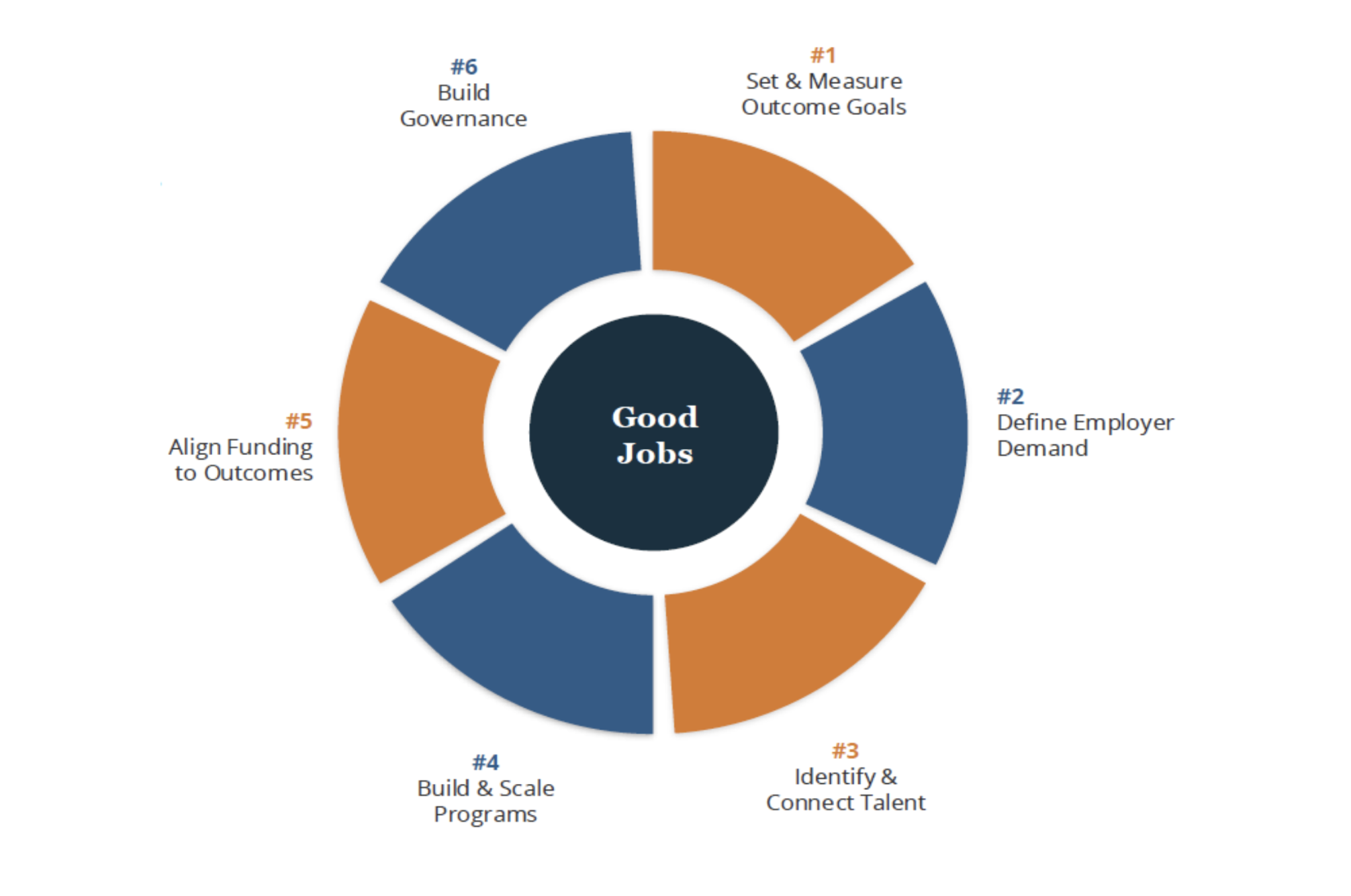
Good Jobs Framework
Implementation is sequenced to reflect this dual focus, with each phase building on the last through the Good Jobs Program Fund:
✅ Round 1: Planning and Capacity Building
Prepares community colleges and partners through labor market analysis, employer engagement, career pathway mapping, and goal setting to support future program investments.
✅ Round 2: Programmatic Investments
Funds the expansion, redesign, or creation of workforce programs aligned with regional demand, connecting residents to good jobs and leveraging public funding such as Pell Grants.
✅ Round 3: Regional and Systems Investments
Scales effective strategies across the region by strengthening shared pathways, aligning data systems, deepening employer partnerships, and building a sustainable regional talent system.
Healthcare as a Proof Point
Healthcare illustrates both the scale of regional workforce demand and the potential effectiveness of the Good Jobs WNC approach. Across Western North Carolina, there are approximately five job openings for every one job seeker in healthcare support roles. The region has also seen more than 24,000 job postings for registered nurses. A substantial share of the positions available are entry-level roles requiring limited prior experience.
These conditions create a clear opportunity for workforce alignment. Demand is already established, and entry points into the sector are accessible. When paired with targeted training and support, these roles can serve as on-ramps to higher-paying, more stable career pathways. The U.S. Bureau of Labor Statistics projects that healthcare occupations will continue to grow at a rate well above the national average, driven by both population aging and increased demand for services. In this context, regional efforts to align training with healthcare workforce needs are not only responsive but necessary.
Community colleges are central to this strategy. In rural regions, they often serve as the primary institutions capable of delivering short-term, employer-aligned training. Their role within Good Jobs WNC reflects a broader recognition that effective workforce systems must be rooted in institutions that are both accessible and responsive to local labor markets.
Addressing Structural Barriers to Participation
While sector alignment is critical, workforce participation is shaped by more than training availability. Regional planning discussions have consistently identified structural barriers that limit individuals’ ability to engage in workforce pathways.
These barriers include the cost and availability of childcare, rising housing costs, transportation challenges, and the upfront expenses associated with training programs, such as equipment and certification fees. There is also an increasing emphasis on the role of employers in supporting workforce stability through wages, retention strategies, and investment in employee development. Workforce development efforts that do not address these constraints risk limiting participation and reducing overall effectiveness. At the same time, they highlight broader system gaps, particularly the underfunding of community colleges and childcare infrastructure, both of which are essential to sustaining workforce participation.
A Model for Regional Recovery
Western North Carolina’s recovery effort is notable not only for its scale but for its level of coordination. The alignment of community colleges, employers, philanthropic partners, and regional leadership creates conditions that are relatively rare in regional workforce development efforts.
The Good Jobs WNC initiative aims to connect at least 1,200 residents to family-sustaining employment over the next three years while building the infrastructure necessary to sustain those outcomes over time. If successful, the initiative could serve as a model for how regions approach both recovery and long-term workforce strategy. Rather than treating workforce development as a series of disconnected programs, it positions it as a coordinated system tied to economic development, public health, and regional resilience.
Western North Carolina will recover. The more consequential question is whether that recovery results in an economy that expands access to opportunity or reinforces existing disparities. Good Jobs WNC represents an effort to move toward the former.
References
America Achieves. (2025). Good Jobs Economy initiative. https://www.americaachieves.org/articles/good-jobs-economy-launches
Braveman, P., & Gottlieb, L. (2014). The social determinants of health: It’s time to consider the causes of the causes. Public Health Reports, 129(Suppl 2), 19–31. https://pmc.ncbi.nlm.nih.gov/articles/PMC3863696/
NewsBreak. (2026). Good Jobs WNC regional workforce initiative. https://www.newsbreak.com/asheville-nc-daily-brief-373360443/4536637732103-good-jobs-wnc-regional-workforce-initiative
North Carolina Department of Commerce. (2025). Labor market impacts of Hurricane Helene: Early insights from Western North Carolina. https://www.commerce.nc.gov/news/the-lead-feed/labor-market-impacts-hurricane-helene
North Carolina Governor’s Office. (2025). Governor Stein highlights ongoing efforts to expand access to good jobs with good wages. https://governor.nc.gov/news/press-releases/2025/06/30/governor-stein-highlights-ongoing-efforts-expand-access-good-jobs-good-wages
Strada Education Foundation. (2026). Western North Carolina workforce demand: Manufacturing and healthcare industries.
U.S. Bureau of Labor Statistics. (2025). Occupational outlook handbook: Healthcare occupations. https://www.bls.gov/ooh/healthcare/
WNC Health Policy Initiative. (2026). Workforce Development Work Group brief: Good Jobs Western North Carolina initiative.
Good Jobs WNC. (2026). Good Jobs Western North Carolina overview materials.
Disclaimer
This content was developed by the WNC Health Policy Initiative in consultation with people and organizations with connections to the health of people of Western North Carolina. Individual or organizational opinions, findings, conclusions, or recommendations are those of the relevant author(s)/interviewee(s) and do not necessarily reflect the view of the WNC Health Policy Initiative or its host institutions of the University of North Carolina Asheville (UNCA), Mountain Area Health Education Center (MAHEC) or our funders.
